


You know the feeling. The little green owl checks in every day. Your streak climbs and your points climb. And the moment someone actually speaks to you in Spanish, you freeze.
That’s not a talent problem. It happens to almost everyone who learns the way most apps ask them to.
Here’s why and what your brain needs instead.
What Duolingo Actually Gets Right
Let’s give credit where it’s due. Duolingo lowers the barrier to entry more than almost anything else out there. You can learn anywhere, often for free, in bite-sized lessons that fit into a real life. For a lot of people, it’s the reason they picked up a language again at all. That matters.
Gamification works, too. Streaks, points, small wins – they keep people coming back. And showing up regularly beats not showing up at all.
But being busy with a language and being able to speak it are two different things. That’s the gap most people don’t notice until months in.
What the Research Actually Says About Duolingo
Two independent research reviews (Shortt et al. (2023) and Rouabhia & Kheder (2024)) arrive at a similar conclusion: most Duolingo studies look at how well the app’s game design keeps people engaged, not at how well it builds real conversation skills.
Free speaking, everyday listening comprehension, holding an actual conversation, these are rarely measured, and rarely trained, in the research behind the app.
There’s another piece worth knowing: since April 2025, Duolingo has leaned more heavily on AI-generated course content, and its CEO has said publicly that the company accepts some quality trade-offs in exchange for speed. That’s a reasonable business decision. It just doesn’t do much for your fluency.
Busy vs. Capable: What Your Brain Actually Needs
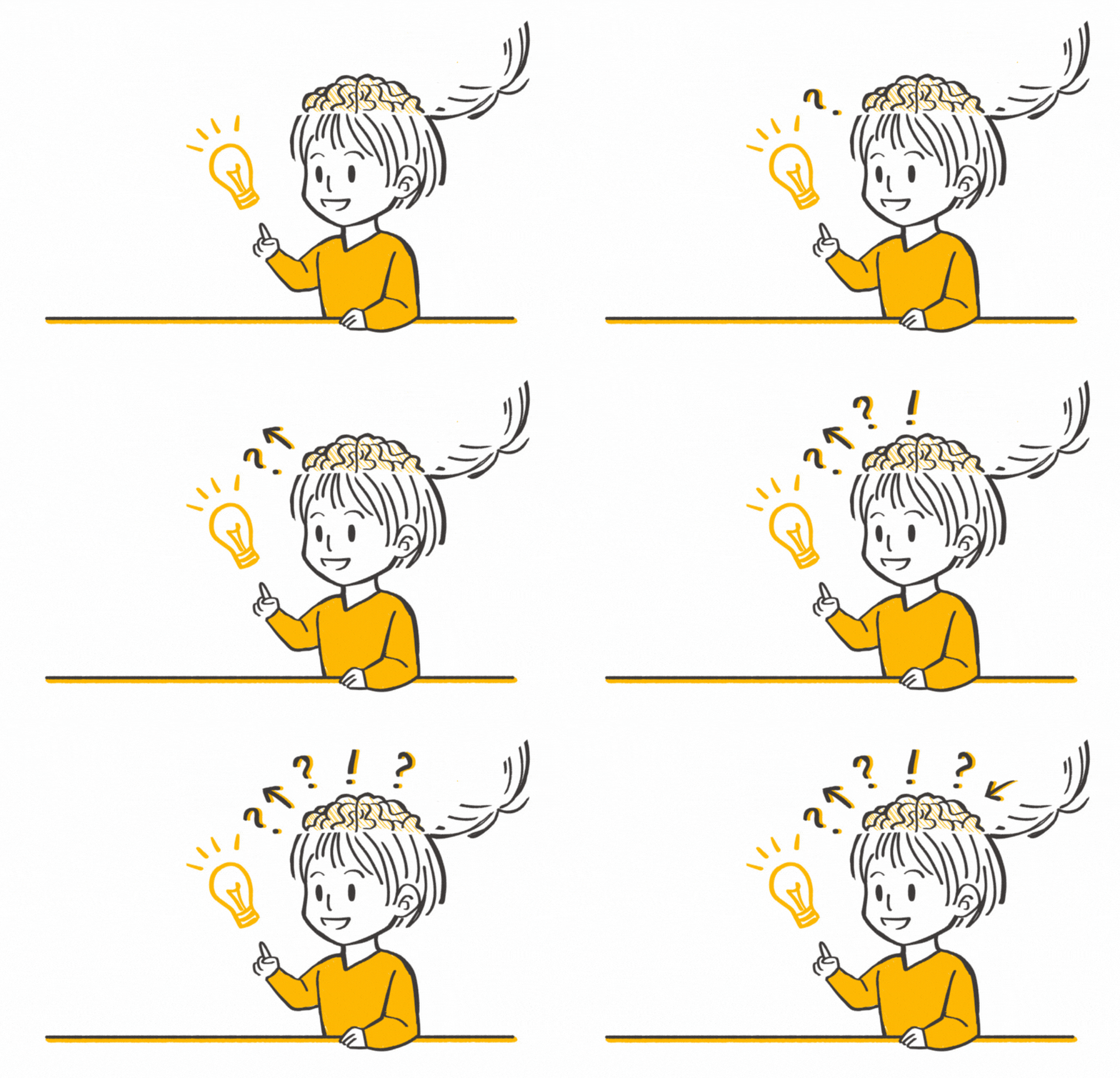
Language learning happens on two distinct levels in the brain.
The first is your explicit system: conscious knowledge. Grammar rules, individual words, explanations. Anything you have to actively think through and recall.
The second is your implicit system: your feel for the language. You hear a sentence and sense whether it sounds right. You speak without doing math in your head first. This is where fluency actually lives.
Apps like Duolingo mostly train the explicit system: you tap answers, match words, click the right option. It feels productive and up to a point, it is.
But fluent speech comes from the implicit system. And that system builds through something different: whole sentences, in meaningful context, with sound, rhythm, and repetition. That’s exactly what your brain barely gets from tapping vocabulary.
Why Memorizing Vocabulary in Isolation Never Works
Vocabulary drills feel productive fast and that’s exactly the problem. You learn twenty words today, feel accomplished, and within days most of them are gone. That’s not a memory issue. It’s how your brain stores language in the first place.
Words are never filed away on their own. They’re stored inside sentences. You don’t really remember the word “get” — you remember “Can I get a coffee?” or “I didn’t see that coming.” Vocabulary drills rarely give your brain that sentence pattern to hold onto.
You notice this the moment a real conversation happens: you search for the word in your own language, then the translation, then the grammar and the moment has already passed. That’s not you failing. That’s the predictable result of a method that was never built with your brain in mind.
Why Whole Sentences Make the Difference

When you learn in complete sentences, something different happens in your brain:
- You store structures, not just isolated words.
- You absorb word order automatically.
- You pick up on rhythm and stress without trying to.
- You can swap out pieces: “Can I get a coffee?” quickly becomes “Can I get a ticket?”
Instead of recalculating every word from scratch, you’re pulling from patterns you already have. Your brain loves patterns. That’s efficient and in conversation, it suddenly feels easy.
How brain-friendly Puts This Into Practice: Real Movie Scenes and the Birkenbihl Approach 4.0
At Brain-Friendly, we work with real movie scenes and dialogue, the way native speakers actually talk. No artificial textbook sentences, no stilted “how may I help you” examples.
The foundation is the Birkenbihl Approach 4.0. Sentences are de-coded line by line, so you grasp the structure without memorizing grammar rules first.
For speaking to eventually feel natural, your brain needs one thing above all: repetition. Lots of it. Fluency isn’t built by understanding alone. It’s built by forming neural connections, and that mostly happens through relaxed, repeated listening. It’s also exactly why people learning a language abroad tend to pick it up so fast: not because the air is different, but because the language is running in the background constantly. This is sometimes called background listening, and it’s one of the most effective habits you can build into an ordinary day.
How to Actually Use Duolingo Well
You don’t have to give Duolingo up. Keep it as a light daily habit, just pair it with a clear plan:
- Use Duolingo for daily activation and habit-building.
- Spend 10 minutes a day on real sentence-based practice with context. The movie scenes following the Birkenbihl Approach 4.0 work well here.
- Repeat whole sentences on purpose, instead of piling up new isolated words.
- Say sentences from your learning material out loud – in the shower, on a walk, wherever fits your day.
- And whenever possible use background listening to build the neurological pathways to speaking accent free.
That’s how “staying busy” slowly turns into actually speaking.
Your Next Step
If you feel like you’ve been “learning” for years and still can’t really speak, that’s not on you. It’s on what your brain has been given to work with so far.
Give it what it actually needs: whole sentences, real scenes, sound, and context.
Try Brain-Friendly free for 7 days. Spend 10 minutes a day with real movie scenes using the Birkenbihl Method 4.0, and notice how your feel for the language starts to shift. No risk. No vocabulary stress.
FAQ
FAQ: Duolingo, Fluency, and brain-friendly Learning
Plenty of people stay motivated with apps for years but still don’t make real progress speaking. These are the questions that come up most.
Duolingo is genuinely good for daily habit-building and motivation. For real fluency, especially free speaking, you need to pair it with whole-sentence training in real context.
Like most language apps, Duolingo is built on classic vocabulary drilling underneath — just with a more modern interface. And drilling is still drilling. Language needs to be experienced to really sink in. Movies come closest to real life: real voices, real situations, real rhythm. That’s exactly why the Birkenbihl Approach 4.0 works with movie scenes.
Because Duolingo mostly trains your explicit system. You learn words, but not how native speakers actually put them together — natural rhythm, the sound of a real conversation, the small quirks of everyday speech. None of that gets much attention. Speaking is learned through listening. Not once, but on repeat, until the patterns settle into your brain. That’s the whole idea behind background listening at brain-friendly.
Sources:
Shortt et al. (2023): Gamification in mobile-assisted language learning: A systematic review of Duolingo literature
Rouabhia & Kheder (2024): Using Duolingo in Teaching and Learning Vocabulary: A Systematic Review
CEO Louis von Ahn (2025): Memo regarding Duolingo and AI